 From “Leveling Anxiety” to “Rational Takeover”: What Game Asset Trading Has Always Lacked Is Not “a Place to Sell Accounts”
The moment a player decides to buy or sell an account, it is usually not because he “wants to speculate,” but because he does not want to spend the only two hours left after work on a stretch of repetitive labor that has long been designed into the game. How long does it take to level an account that can get into a raid? How many weeks does it take to farm a set of presentable gear? And once the patch updates, everything starts over again. This time cost is pushing more and more ordinary players toward the same question: rather than starting from zero, why not take over an account that is already “mature”? The problem is that when demand genuinely exists, the answer from the supply side has long remained at the level of “matchmaking”: someone lists, someone buys, the platform takes a fee, and the players bear the rest of the risk themselves. Game asset trading today is not short of another trading gateway; what is truly scarce is a set of system capabilities that gives both buyers and sellers the confidence to hit “confirm.”
From an industry data perspective, this has long ceased to be a marginal demand. In 2025, China’s online game asset trading market generated about USD 5.68 billion in sales revenue, and it is projected to exceed USD 12.4 billion by 2032, with a compound annual growth rate of nearly 12%. The trend toward account assetization is also strengthening: rare skins, limited-edition items, and high-rank rankings are no longer just “things inside an account,” but digital assets that can be priced and transferred. Yet alongside this expansion is a rough trading experience. Many platforms still only publish information and match buyers with sellers. Account value lacks unified standards, bargaining costs for both sides remain high, and problems such as recovery, account theft, and fund safety repeatedly erode players’ trust in “third-party trading.” The industry is undergoing a shift from “matchmaking behavior” to “systemized service.” Whoever can turn security, pricing, and fulfillment from “promises” into “executable processes” will truly be able to capture the next stage of this market.
The pain points players face are more direct than the data. A report by Black Cat Complaints for the first half of 2026 noted that the game account trading sector is rife with chaos; some platforms attract users with the marketing gimmick of “guaranteed compensation if the account is recovered,” but after an account is stolen, recovered by the original seller, or banned, they set up multiple hurdles and refuse to pay. Cases recorded by the Guangzhou Consumer Council are more specific: one buyer spent more than RMB 10,000 on an account and completed rebinding and real-name verification. A year later the account was stolen, and the first and last digits of the newly bound phone number closely matched those of the original seller. The platform was willing only to refund a certain percentage under its “compensation guarantee” clause. Another buyer paid but, due to the seller, could not complete rebinding for a long time; the platform compensated only part of the amount on the grounds that the “seller’s balance was insufficient.” Another buyer could not log in at all after payment because the account was bound to the original owner’s real-name information and failed facial recognition; customer service refused to handle it, saying “facial-recognition restrictions are not covered by the compensation guarantee.” Courts and police repeatedly warn of the same thing: off-platform private transactions, confirming receipt in advance, and trusting transfer screenshots are the most common entry points for virtual asset disputes. The essence of these pain points is not that “players are too gullible,” but that the transaction chain lacks a party that truly intervenes in the entire fulfillment process—funds are not escrowed, account inspection has no standards, rebinding has no coordination, and after-sales has no backstop. As a result, all the risk naturally flows back to the players.
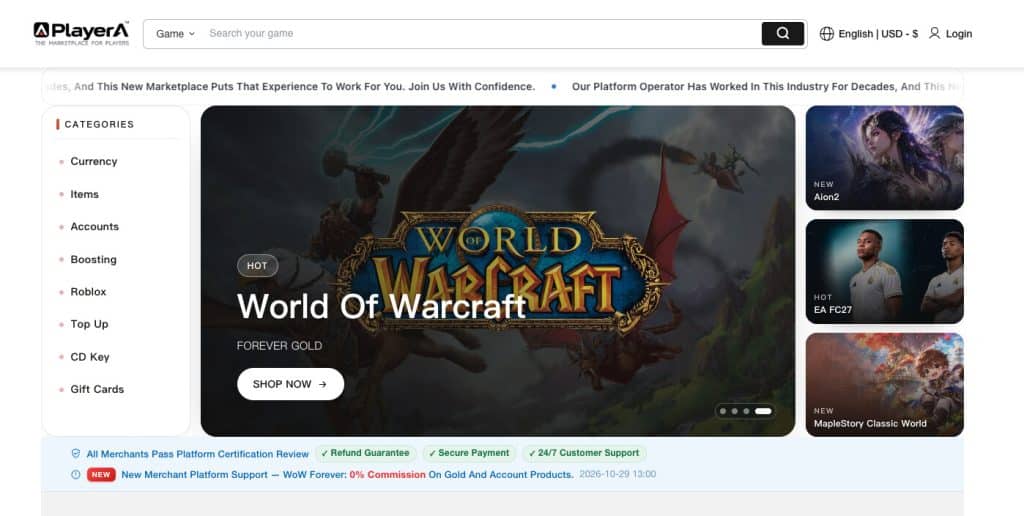
This is exactly the question playera.com — a global marketplace playera is trying to answer. It is not a platform that “opens another marketplace and lets you gamble on your own,” but an attempt to move trading from “matchmaking” to “systemized service.” In practice, a transaction is broken down into stages in which the platform can intervene: after the buyer pays, funds go into platform escrow rather than directly into the seller’s pocket; in the account inspection stage, the platform or coordinated staff verify that the account information matches the description, rather than leaving the buyer to gamble on authenticity based on a few screenshots; in the rebinding stage, there is a clear coordination process and retention of evidence, rather than “the money is paid, and whether you get the account depends on luck”; and funds are released only after the buyer confirms the account is usable and the binding information has been changed. For “recovery,” the scenario buyers fear most, the value of playera.com lies not in shouting “compensation guarantee,” but in linking seller identity verification, transaction record retention, and after-sales response into a traceable chain—when the platform can establish “who sold it, what was sold, and what was delivered,” post-transaction accountability is not an empty phrase, and compensation has an executable starting point.
But even with better tools, trading rationality remains the last line of defense. The courts’ warnings are worth copying into every prospective trader’s memo: choose official, legitimate channels or authorized third-party platforms where possible; do not communicate privately off-platform or jump to other software to operate; never confirm receipt in advance; and keep complete chat logs, transfer receipts, and account screenshots during the transaction. Police also repeatedly emphasize that any request to transfer or top up funds in advance for any reason before a deal is concluded can basically be judged as fraud. Game account trading has never been a “zero-risk” activity. Third-party platform guarantees and escrow reduce risks that can be managed systematically; they do not eliminate all risks. A truly rational view of trading is this: treat the platform as a tool for reducing information asymmetry and fulfillment uncertainty, not as a guarantee of “certain profit with no loss”; before buying, know whether you want the experience or the asset; before selling, know the account’s real value and the boundaries of delivery; and during the transaction, hold the three bottom lines of not leaving the platform, not confirming in advance, and not leaving evidence gaps.
The trend of game assets moving from “personal saves” to “transferable virtual property” will not reverse. But a healthy market should not require every ordinary player to train themselves into an anti-fraud expert before buying an account. The significance of playera.com is not to promise a world without risk, but to take over the stages that players originally had to bear alone—funds, account inspection, rebinding, and after-sales—one by one, turning them into service processes that are predictable, traceable, and accountable. When tools are tools and rationality is rationality, game trading can move from a “gamble” to an ordinary consumer choice.

